The short answer
How to pack books for moving: the small-boxes-only rule, the packing method, protecting valuable books, and moving a whole home library without injuries.
Books are the great packing trap: nothing is denser. A medium box of books can hit 60 pounds, blow out its bottom on the stairs, and wreck someone's back — and a large box of books is essentially unliftable. The rules for packing books are simple but non-negotiable, and they matter more than for almost any other item. This guide covers the right boxes and method, protecting valuable or special books, and packing an entire home library without injuries.
The One Rule: Small Boxes Only
This is the rule that prevents everything bad: books go in small boxes, never medium or large. A small box full of books is already 30–40 pounds — right at the safe carrying limit. Fill a medium box with books and you're at 50–60 pounds with a bottom that's about to fail; a large box is a guaranteed blowout and an injury. Liquor-store and book-store boxes (small, sturdy, double-walled — see where to get free boxes) are ideal. If you only have bigger boxes, fill the bottom third with books and the rest with light items (linens, pillows) to cap the weight.
The Packing Method
- Reinforce the bottom: extra tape across the seam — books find every weak box bottom.
- Two ways to pack them: flat-stacked (spine down or alternating) for sturdy hardcovers, or standing upright spine-against-the-box-side (like on a shelf) — never spine-up, which damages the binding over time.
- Heaviest at the bottom of the box, lighter paperbacks on top.
- Fill gaps with paper so books can't shift and corners can't get crushed.
- Don't overfill — the box should close flat and stay under ~40 lbs. Lift-test it; if it's a strain, take some out.
- Label HEAVY on two sides (the labeling system) so whoever lifts it sets their grip and the box rides low in the stack.
Valuable, Rare, and Special Books
Treat collectible, antique, signed, or sentimental books as fragiles, not freight:
- Wrap individually in acid-free paper or clean packing paper (not newspaper — ink transfers to pages and covers).
- Protect the corners and edges of fine bindings; pack snug so they can't rub against each other.
- Keep them flat and don't over-pack the box.
- For genuinely valuable collections, consider carrying them yourself and documenting them for coverage — the same logic as other high-value items.
- Leather-bound books dislike humidity and temperature swings — relevant if they're headed to storage (climate-controlled only).
Packing a Whole Home Library
A serious book collection is a real project. Tactics that help: declutter first (donate the ones you won't reread — libraries, Goodwill, and More Than Words in Boston take them, and it's deductible), pack over several sessions rather than one exhausting day, and number the boxes if you want to reshelve in order at the new place (part of the numbered-inventory approach in the labeling guide). And accept the truth every reader resists: a wall of books is a lot of weight to move — fewer books is genuinely less moving cost (decluttering).
Books and the Move Itself
Because book boxes are so heavy, they're a real factor on an hourly move — heavy boxes on stairs slow a crew and (with the wrong mover) can trigger stair fees. With us there are no stair fees, and our crews are built for exactly this kind of weight (the technique is in getting heavy items upstairs). Pack them right and labeled, and the heaviest part of your move goes smoothly.
Packing Books FAQ
What size box should I use for books?
Small boxes only — a small box of books is already 30–40 lbs. Medium and large boxes get too heavy to lift safely and blow out their bottoms.
Should books be packed flat or standing up?
Either works for regular books — flat-stacked, or upright with the spine against the side of the box (like a shelf). Never spine-up, which strains the binding.
How do I pack valuable or antique books?
Wrap individually in acid-free or clean paper, protect corners, pack snug and flat, don't overfill, and consider carrying the most valuable ones yourself with documentation for coverage.
How do I move a big home library?
Declutter and donate first, pack in small boxes over several sessions, label HEAVY, and number boxes if you want to reshelve in order. Less weight = less cost.
Lots of books? We move them every day — no stair fees, crews built for the weight. Get a free quote. 1,244+ Google reviews, since 2002.
Find our moving guides faster on Google
Add Boston Best Rate Movers as a preferred source and Google shows our answers first when you search — including in AI Mode.

Boston Best Rate Movers
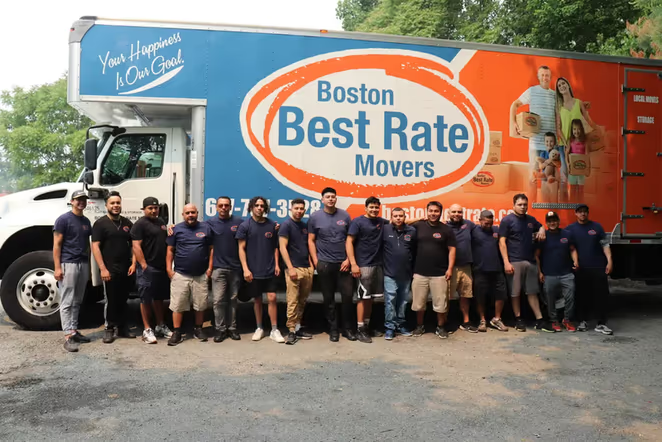
The Boston Best Rate Movers team shares moving tips, Boston neighborhood guides, and cost-saving strategies drawn from 24+ years and 43,126+ completed moves across Greater Boston.
See All Posts